Why AI Agents Need Identity and Wallets


If you've ever asked a chatbot to write an email or generate an image, you've already interacted with an AI agent. But things get a lot more interesting when that agent needs to do something in the real world, like book a flight, pay for an API, or even send money to another agent for a service.
We’re quickly moving into an era where AI doesn’t just assist us but takes action on its own. This “Age of Agentic AI” will and is already transforming everyday life and whole industries, from personal productivity to global finance. But with that progress comes a serious challenge where autonomous systems can be exploited if they don’t have strong identity and financial safeguards. Recent events have already shown how agents can be weaponized for cyber-espionage when those protections are missing.
This article breaks it down in simple terms, what exactly are AI agents? Why do they need secure digital “passports” and wallets? And how does this infrastructure open up a massive opportunity at the intersection of AI, stablecoins, and autonomous systems while helping prevent the threats we’re starting to see?
What Are AI Agents?
Basic AI tools like ChatGPT or Siri respond to questions and commands (prompts). They take input, process it, and return an output. Now AI agents don't only respond but also act. They can plan, make decisions, and carry out tasks in the real world by chaining together tools like web searches, APIs, or even other agents to complete a goal from start to finish.
A vivid example would be, a traditional AI is more like a calculator, it calculates numbers when you ask. But an AI agent is like a personal shopper. You say, "Plan a weekend getaway under $500," and it researches flights, books hotels, compares prices, and charges your card, all without your intervention.
In 2025, we've seen explosive growth in the agentic AI space with projections for agents to handle 30% of routine enterprise tasks by 2027, according to a Forrester study. Popular frameworks like LangChain, AutoGPT, and CrewAI let developers build these in days, not months
Examples include:
-
Personal agents: These manage your calendar, order groceries, or even negotiate bills.
-
Business agents: They automate customer support, analyze market data, or optimize supply chains.
-
Multi-agent systems: These are teams of agents collaborating, like a "research bot" querying data from an "analysis bot" for insights.
Now, this freedom to act introduces new problems. How does an agent prove it has the permission to perform an action? And how can it pay for services without a human approving every step? Having identity and wallets solve this because without them, autonomous agents can become high-risk actors operating without accountability or financial control.
Why AI Agents Need Wallets
AI agents are participants in the digital economy. To run compute, access data, or use services, they need to be able to make payments. The problem is that today’s payment systems were designed for humans. They rely on card numbers, email logins, and manual compliance checks, none of which work for autonomous software. So agents need something faster and more flexible which is digital wallets that are built for them.
The Payment Problem in the Agentic World
AI agents operate at a pace and volume that humans never could. A single research agent might request from 100 different APIs in a few seconds, with each request costing $0.01–$0.10. This creates a problem for traditional payment systems as they simply weren’t built for this type of activity.
Here’s why they are not ideal:
-
High Friction: Systems that require OAuth logins, card numbers, or email verification don’t make sense for autonomous bots.
-
Inefficiency: Traditional rails often batch payments, which slows down actions that need to happen instantly. And fees quickly eat into micropayments.
-
Scalability Limits: Networks like Visa or ACH can’t support trillions of tiny, sub-dollar transactions happening continuously.
With self-custodial digital wallets, agents can hold stablecoins or fiat value and transact or stream payments from it.
But now this kind of freedom introduces another risk. If an agent controls money, what stops it from overspending? Or paying an unverified counterparty? Identity becomes essential in this instance, to ensure these agents transact safely, responsibly, and within defined limits.
Why AI Agents Need Identity
Identity generally isn't just about “who are you?” but “what can you prove?” For AI agents to participate in real transactions, especially in highly regulated spaces like finance or healthcare, they must carry verifiable credentials (VCs). These credentials act as cryptographic proof of things like authorization, compliance, permissions, or ownership.
The Identity Imperative
Human beings prove who they are with documents like passports or driver's licenses. They’re trusted documents that show where you’re from, whether you’re allowed to travel, and so on.
AI agents need their own version of that. That’s what Decentralized Identifiers (DIDs) are: a permanent digital identity that isn’t controlled by one company or government. When you combine a DID with Verifiable Credentials (VCs), you get something that works like a digital passport. An agent can prove things like “this agent has passed KYC” or “this agent is allowed to spend up to $100/day” but without exposing private information.
The reason why identity matters so much for agents is because agents don’t act for themselves, they act on behalf of people and organizations. That means whatever an agent does carries real-world consequences.
If an agent isn’t properly verified, things can go very wrong: it could move money illegally, access sensitive data, or make decisions it wasn’t authorized to make.
This becomes particularly critical in regulated industries like:
-
Finance: Automated trading and payouts must be traceable. Regulators need an audit trail showing who initiated a transaction even if it was an agent.
-
Healthcare: Access to patient records must be restricted to only those who are verified and approved.
-
Legal: If an agent is drafting or signing contracts, it must be crystal clear that it has permission to act on behalf of the actual party.
The industry isn’t leaving identity to chance. The W3C AI Agent Protocol Community Group is already working on global standards to make sure agents can collaborate securely and the core of that effort is verifiable credentials (VCs).
Some platforms are already implementing this. For example, APort.io issues agent “passports” with Level-4 assurance, the same standard used in financial KYC. Before an agent takes any action, the system checks the passport and verifies whether the request follows policy. The whole check happens in under 200 milliseconds, so security doesn’t slow anything down.
This highly matters because organizations are hesitant to adopt agents without strong guardrails. Cloudera’s 2025 industry report showed that 53% of companies cite privacy and accountability as the biggest blockers to rolling out agent automation. If an agent makes a bad call, who’s responsible, the model, the developer, or the business? That uncertainty is called “authority ambiguity.”
VCs solve that by giving agents proof of authorization that can be logged, audited, and even used as legal evidence when needed. Every decision can be traced back to a verified identity and a set of clear permissions.
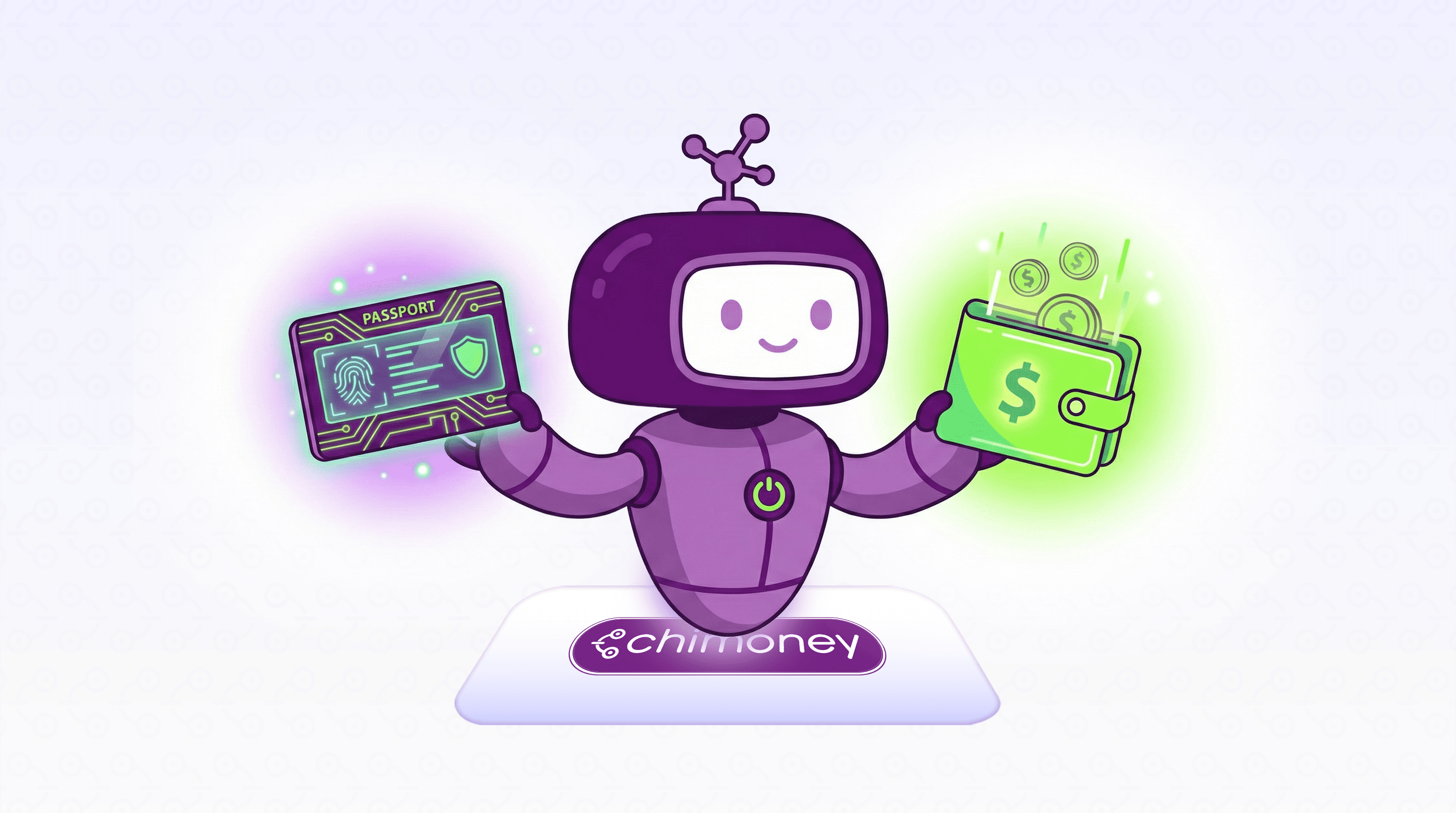
Wallets + Digital Identity “Passports” = The Complete Agent Stack
A payment wallet and a digital passport each solve a different trust problem for AI agents: a wallet lets an agent pay for things while a passport proves the agent is allowed to act. On their own, they’re useful but combined, they enable autonomy without losing control.
When a wallet is directly tied to a verifiable agent identity, every action can be governed by policy. Companies can set rules like spending limits or triggers for human approval. If an agent tries to step outside its permissions, the payment fails instantly and the attempt is logged with a cryptographic record of who tried to do what, and why.
The result is a built-in audit trail, and compliance with frameworks like GDPR, HIPAA, and SOX becomes automatic because every identity check and every transaction is tamper-proof by default.
This also simplifies development. Today, teams glue together identity APIs, wallet services, KYC vendors, fraud tools, and transaction monitors just to let an agent transact safely. With a combined wallet + passport stack they are able to create agent, issue a passport, set policies, fund wallet and the agent can fully operate.
This is why agent-readiness platforms (identity + payments + policy) command much higher valuations than payments-only solutions as they remove risk and accelerate go-to-market.
Real-World Use Cases
Here are practical examples of how agents operate safely when identity, payments and policy limits are combined.
1. Research Agent
A research bot gathers market intelligence by querying paid APIs, spending about $0.05 per request using stablecoins. With a linked wallet and passport, the business can enforce rules such as a $50 daily spend cap and a whitelist of approved data providers.
The outcome is 75% cost savings and a complete financial audit trail for accounting teams.
2. Customer Support Refund Agents
A support team uses multiple agents to manage refunds. One agent is authorized to approve refunds under $50 automatically, while anything above that is escalated to a human based on policy. Each agent’s passport proves its authority before any payout is made.
The outcome is Zero unauthorized refunds and 10× faster ticket resolution.
3. Healthcare Prior-Authorization Bot
An insurance agent verifies patient eligibility using verifiable credentials and pays pharmacies in USDC when claims are approved. With Level-4 identity assurance and wallet policies, spending is capped at $500 per claim to meet compliance standards.
The outcome is prior authorizations go from days to minutes without violating HIPAA safeguards.
4. Multi-Agent Supply Chain
Procurement agents negotiate with suppliers and make conditional payments on delivery. Interledger-style interoperability enables cross-border settlement, while passports ensure each agent enforces contract terms before releasing funds.
The outcome is instant settlement across suppliers and regions, driven by autonomous decision-making.
The Risks of Skipping Identity and Wallets
When teams deploy autonomous agents without pairing identity + wallets + policy controls, the results are:
-
Runaway Spending: Without enforced spending limits or approvals, agents can burn through budgets fast, for example, a research bot making $200 per day in API calls before anyone notices.
-
Compliance Exposure: Regulators expect explainability. If an unverified agent makes a financial decision or accesses sensitive data, companies can face serious penalties, the EU AI Act allows fines up to 6% of annual revenue for non-compliant automated systems.
-
Integration Overhead: Trying to replicate identity, payments, and policy controls by stitching separate tools together (e.g. Stripe + Okta + custom logic) typically requires 2–3 weeks of development time per agent, and still leaves gaps.
-
No Trust, No Transactions: Agents that cannot prove who they are or what they’re allowed to do get blocked. Enterprises simply will not send money or data to an anonymous bot without a DID and passport-level proof of authority.
How Chimoney Delivers Agent Wallets and Passports
As a licensed Money Service Business (MSB) and Payment Service Provider (PSP) regulated by FINTRAC and the Bank of Canada, we offer the compliance foundation required for safe agent transactions at scale. This allows us to deliver what the market has been waiting for ‘The first combined Digital Passport and Payment Infrastructure for both AI agents and humans.’
Here’s what that looks like in practice:
-
One-Click Agent Wallet Setup: Teams or developers are able to create an agent wallet and it receives everything it needs to operate, a fundable wallet, Interledger wallet address (works like an email address for payments), and W3C-standard DID, in seconds.
-
APort-Powered Identity Assurance: Agents automatically receive L4-assured digital passports with synchronized and customizable policies. Every action is verified in under 200ms, and all approvals, denials, and spending checks are written to immutable audit logs.
We’re building the infrastructure layer that will power identity and payments for both humans and AI agents and our goal is to enable autonomous systems to act safely, compliantly, and within guardrails from day one. Subscribe to our newsletter or follow us to get early access when new agent-driven features go live.
Check out these other posts

Why 2025 Is The Year AI Agents Get Their Own Wallets (And Passports)